Music
Printable Circle of Fifths
A clean circle of fifths for the music stand or the binder: the 12 major keys on the outside, their relative minors inside and the number of sharps or flats in the center ring, with practice staves below.
What you can customize
- Staves per page
Works well in
- Traveler's Notebook Passport
- A6
- Traveler's Notebook Regular
- B6 (JIS)
- A5
- US Half Letter
- B5 (ISO)
- A4
- US Letter
All page sizes, from Passport to A4
Try it in another style
Start from a preset
- Circle of fifths with staves, US Letter Four practice staves under the chart. Open in the maker →
- Circle of fifths, A4 The same chart on European paper. Open in the maker →
- Large chart only No staves, the biggest circle. Open in the maker →
- Pocket reference, A5 For the front of a music notebook. Open in the maker →
Every key on one page
- Outer ring: the 12 major keys, with C at the top.
- Middle ring: the relative minor keys.
- Inner ring: the number of sharps (♯) or flats (♭) in each key signature.
- Practice staves: 0 to 6 below the chart, alternating treble and bass clef.
The chart uses real music symbols and prints the key names the way your language writes them.
How to print the circle of fifths
- Choose a preset and Download PDF → Reading order.
- Print a copy for the music stand and put another at the front of your music notebook.
- Print at 100% (Actual size).
Free sample PDFs
Print at 100% (actual size). Made with the same engine as the maker, so the spacing is exact.
Frequently asked questions
How do I read the circle of fifths?
Going clockwise from C, each key is a fifth higher and has one more sharp. Going counterclockwise, each key is a fifth lower and has one more flat. The inner ring shows the relative minor, which shares the key signature.
Why are F sharp and G flat in the same place?
They are enharmonic: the same pitches written two ways. F sharp major has six sharps and G flat major six flats, so both share the bottom of the circle.
Are the note names in my language?
Yes. The chart prints C D E in English, Do Ré Mi in French and Spanish, and H for B in German and Polish.
What are the staves for?
For writing scales, key signatures and chord progressions while you learn. Choose 0 to 6 staves, alternating treble and bass clef.
Related guides
Related templates
-
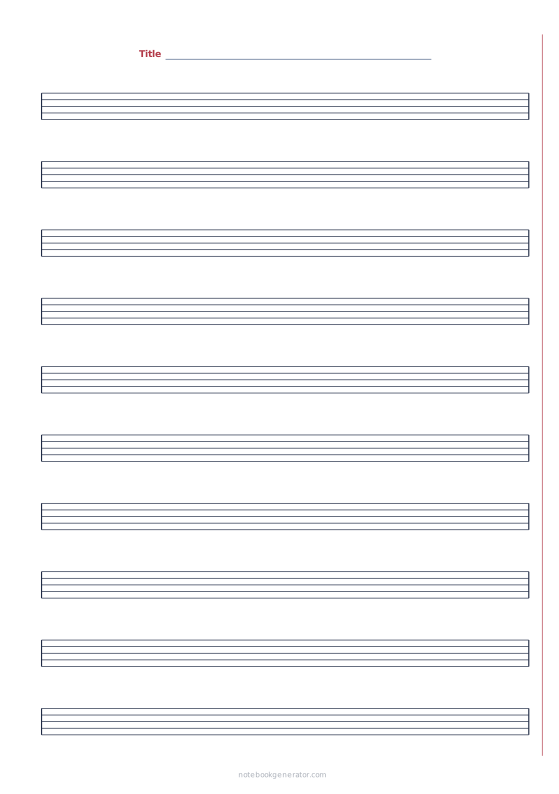
Staff Paper
Blank sheet music with five-line staves, optional clefs and bar lines.
-
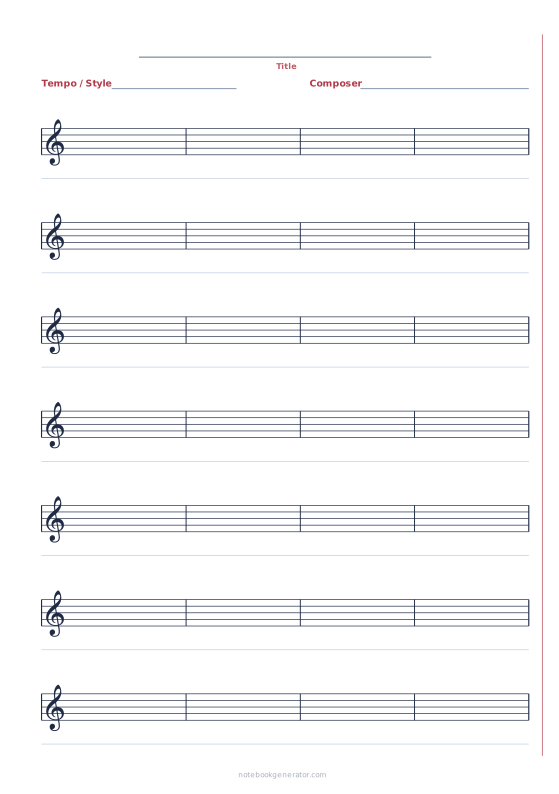
Lead Sheet
Melody staves with room for chord symbols and lyrics, plus a score header.
-
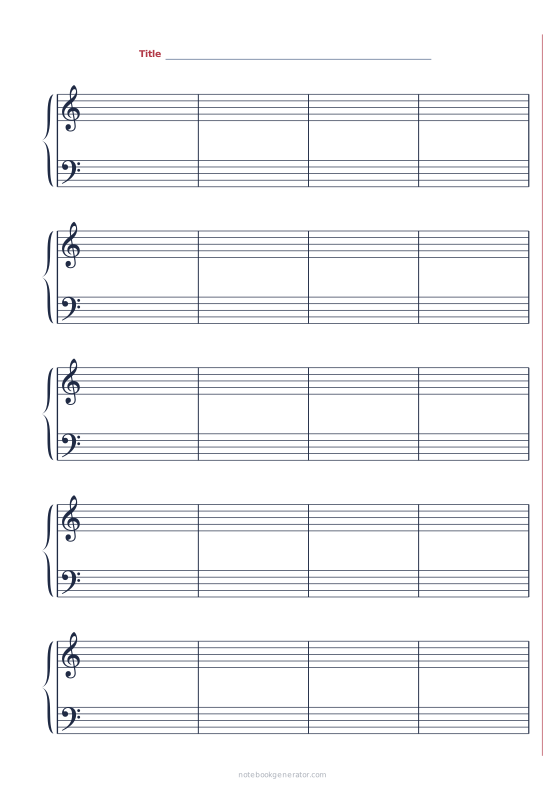
Piano Grand Staff
Treble and bass staves joined by a brace, for piano and keyboard.
-
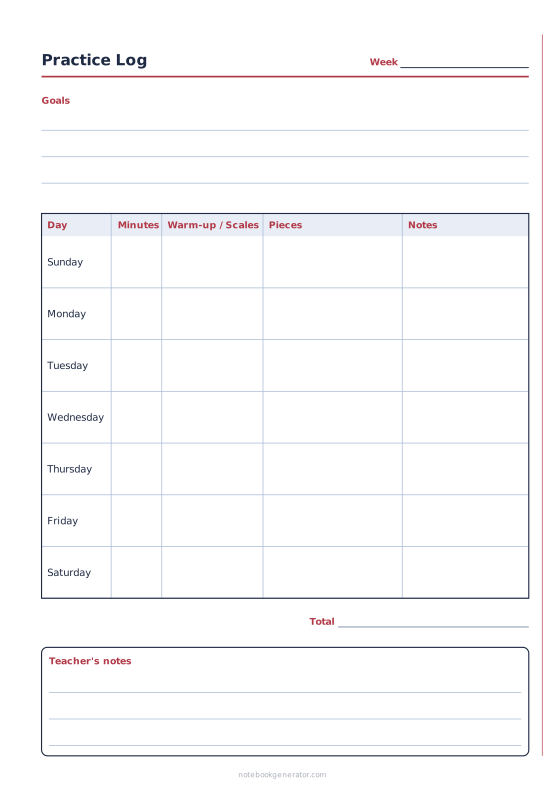
Music Practice Log
A week of practice: minutes, warm-ups, pieces and notes, plus goals and teacher notes.
-
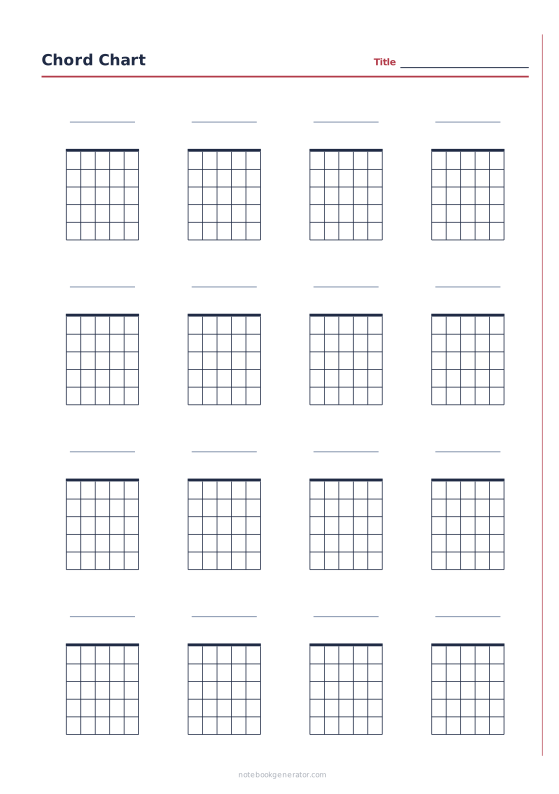
Chord Chart
Blank chord diagrams, or a ready-made chart of common guitar or ukulele chords.