Basic Paper
English Four-Line Paper
Four-line paper for learning to write English letters: every row has four lines and three equal spaces, so children can see exactly how tall a capital, a small letter or a descender should be. The third line is the baseline, marked in red.
What you can customize
- Space height
- Gap between rows
- Second line
- Red baseline
Works well in
- Traveler's Notebook Passport
- A6
- Traveler's Notebook Regular
- B6 (JIS)
- A5
- US Half Letter
- B5 (ISO)
- A4
- US Letter
All page sizes, from Passport to A4
Try it in another style
Start from a preset
- Four-line practice paper, US Letter 3 mm spaces with a red baseline, for upper and lower case. Open in the maker →
- Large rows for beginners, US Letter 5 mm spaces and a dashed second line for first letters. Open in the maker →
- Four-line exercise book, A5 booklet 32 pages folded into a small practice notebook. Open in the maker →
- Compact rows for older students, A4 2.5 mm spaces and a tighter row gap, no red line. Open in the maker →
What’s on four-line paper
Each row is made of four horizontal lines with three equal spaces between them:
- Top line: the height of capitals and tall letters.
- Second line: the top of small letters; draw it solid or dashed.
- Third line: the baseline every letter sits on, in red if you like.
- Bottom line: where tails of g, j, p, q and y end.
In the maker set the Space height (2 to 6 mm) and the Gap between rows (3 to 15 mm). Rows are centred on the page so the margins stay even.
How to print four-line paper
- For loose practice sheets, use the Letter or A4 preset and Download PDF → Reading order.
- For a practice notebook, choose A5 and Print-ready booklet. Print double-sided (flip on the short edge), fold and staple.
- Print at 100% (Actual size) so the spaces keep their exact height.
Free sample PDFs
Print at 100% (actual size). Made with the same engine as the maker, so the spacing is exact.
Frequently asked questions
How do you write letters on four-line paper?
Small letters such as a, c and e sit in the middle space, between the second line and the red baseline. Tall letters (b, d, h, k, l) reach up to the top line, capitals fill the top two spaces, and letters with tails (g, j, p, q, y) drop into the bottom space.
What size should the spaces be?
Set the space height from 2 to 6 mm. Young children starting the alphabet do well with 4 to 5 mm; 3 mm is the common school size, and 2 to 2.5 mm suits older students who already write neatly.
Is this the same as handwriting paper with a dotted midline?
It is similar but has one more line. Primary handwriting paper has three lines, while four-line paper adds a bottom line for descenders, giving three equal spaces. For three-line practice, use the handwriting template instead.
Can I turn off the red baseline?
Yes. Switch off Red baseline to print all four lines in the same grey, which works well on a black-and-white printer.
Related guides
- How to print a booklet double-sidedPrint your notebook PDF at actual size, choose the right duplex setting, and get pages that come out in the right order after folding.
- Paper sizes, margins and binding allowanceWhich printer paper fits which notebook size, how to set margins and the binding margin, and when to use bleed and creep.
- College ruled vs wide ruled vs narrow ruled: line spacing explainedWide ruled is 11/32 in (8.7 mm), college ruled 9/32 in (7.1 mm) and narrow ruled 1/4 in (6.35 mm). Which to choose, plus handwriting paper and rulings worldwide.
Related templates
-
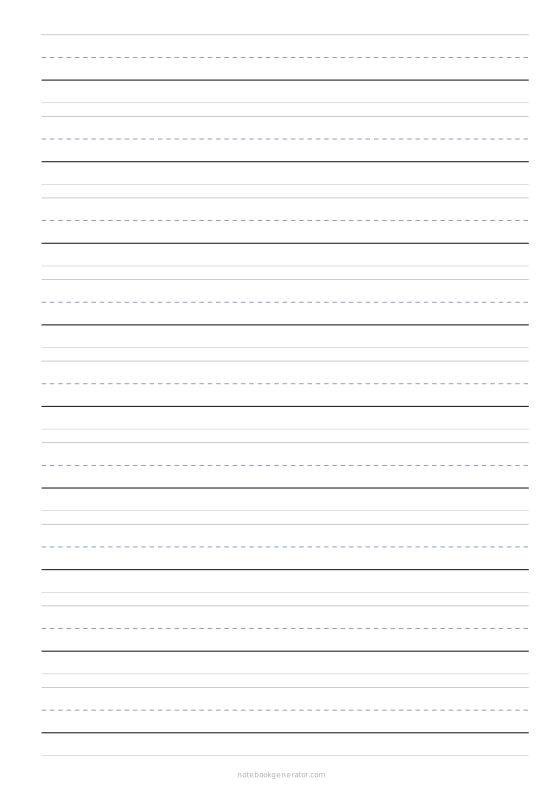
Handwriting Practice Paper
Primary writing lines with a dashed midline for learning to write.
-
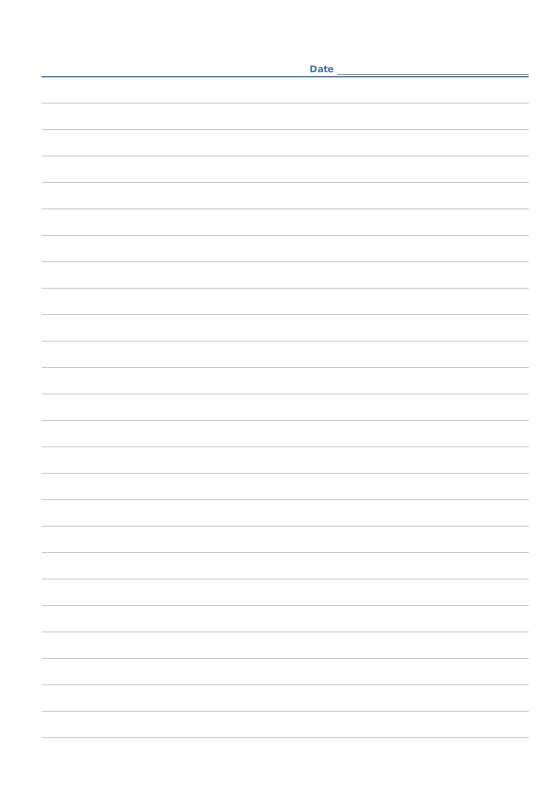
Ruled Paper
Lined writing paper with adjustable line spacing.
-
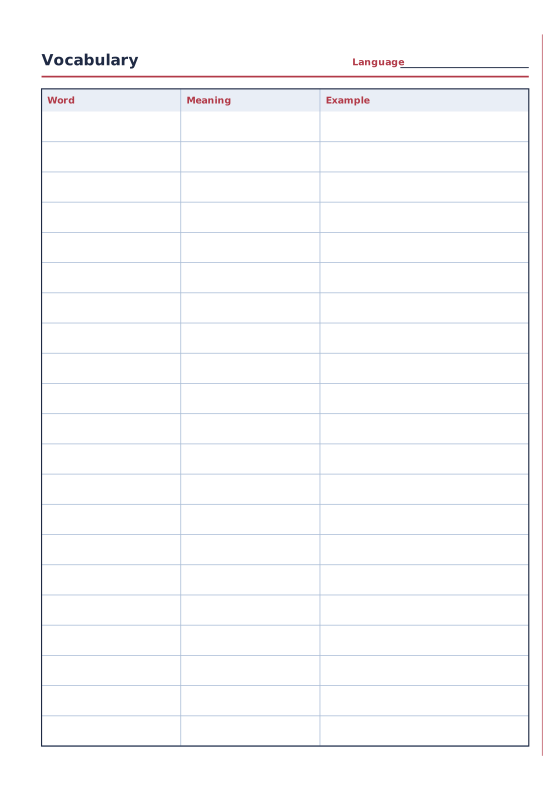
Vocabulary Notebook
Word, meaning and example columns.
-
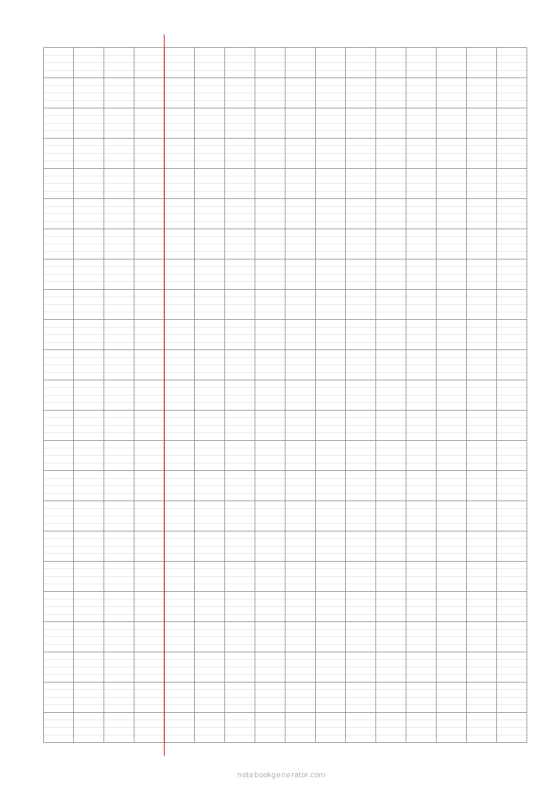
Seyès Ruled Paper
French ruling: 8 mm squares with three fine lines in between and a margin.
-
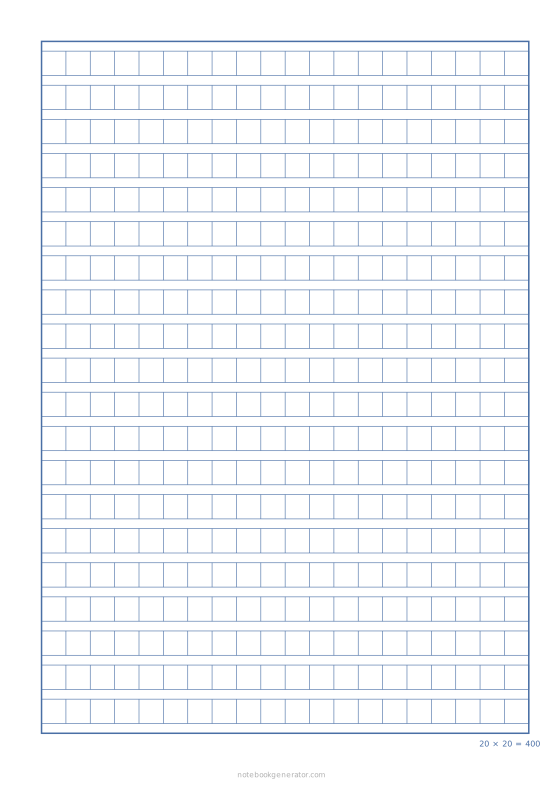
Manuscript Paper (Genkō Yōshi)
Square-cell composition paper: 20 × 20 = 400 characters per page.