Basic Paper
Printable Engineering Graph Paper
Printable engineering graph paper with heavier major lines every centimeter or inch and fine subdivisions between them. Use it for plotting, floor plans, technical sketches and knitting charts.
What you can customize
- Grid unit
- Subdivisions per square
Works well in
- Traveler's Notebook Passport
- A6
- Traveler's Notebook Regular
- B6 (JIS)
- A5
- US Half Letter
- B5 (ISO)
- A4
- US Letter
All page sizes, from Passport to A4
Try it in another style
Start from a preset
- Engineering paper, 5 per inch, US Letter Bold inch lines with five squares per inch, the classic engineering pad. Open in the maker →
- Millimeter paper, A4 1 mm squares with a bold line every centimeter, for plotting and scale drawings. Open in the maker →
- Graph paper notebook, A5 2 mm squares with centimeter lines, printed as a booklet. Open in the maker →
- 10 per inch graph paper, US Letter Fine tenth-inch grid with bold inch lines for data plots and lab work. Open in the maker →
Engineering paper in millimeters or inches
The Graph Paper template draws a precision grid with two line weights. Choose the unit:
- mm: a bold line every centimeter, with the centimeter split into 2 to 20 parts (10 gives classic millimeter paper).
- in: a bold line every inch, split into 2 to 20 parts (4, 5 and 10 per inch are the common engineering grids).
Fine lines are thin and light, so your drawing stays the focus. It suits plotting functions and lab data, floor plans to scale, knitting and cross-stitch charts, and technical sketches.
How to print graph paper
- For loose sheets, use the Letter or A4 preset and choose Download PDF → Reading order.
- For a grid notebook, use the A5 preset and choose Print-ready booklet. Print double-sided (flip on the short edge), fold and staple.
- Always print at 100% (Actual size). Scaling changes every square, which matters for scale drawings.
Free sample PDFs
Print at 100% (actual size). Made with the same engine as the maker, so the spacing is exact.
Frequently asked questions
What is the difference between engineering paper and regular graph paper?
Engineering graph paper has two line weights: heavier major lines every inch or centimeter and fine minor lines between them, so you can count and measure quickly. Regular grid paper has evenly weighted squares; use the Square Grid template for that.
What grid size should I choose?
Engineering pads in the US usually have 5 squares per inch. Lab and data plots often use 10 per inch. Millimeter paper (10 subdivisions per centimeter) is common for scale drawings and physics. You can set anything from 2 to 20 subdivisions per major square.
Will the grid measure correctly when printed?
Yes, as long as you print at 100% or Actual size. Fit to page shrinks the grid. Measure one major square with a ruler, and use the printer calibration guide if your printer is slightly off.
Can I make a graph paper notebook?
Yes. Choose A5, Half Letter or another notebook size, set the page count and download a print-ready booklet. You can mix graph pages with lined or blank pages in the same notebook.
Related guides
- How to print a booklet double-sidedPrint your notebook PDF at actual size, choose the right duplex setting, and get pages that come out in the right order after folding.
- Calibrate your printer for exact sizesMeasure your printer once so pages print at exactly the right size, find its unprintable margins, and line up the front and back of each sheet.
- Paper sizes, margins and binding allowanceWhich printer paper fits which notebook size, how to set margins and the binding margin, and when to use bleed and creep.
- Paper sizes chart: A4, A5, B5 and Letter in mm and inchesA4, A5, A6, B5, US Letter, Half Letter and Legal in millimetres and inches, how A4 compares with Letter, and which size suits a journal, planner or school notebook.
Related templates
-
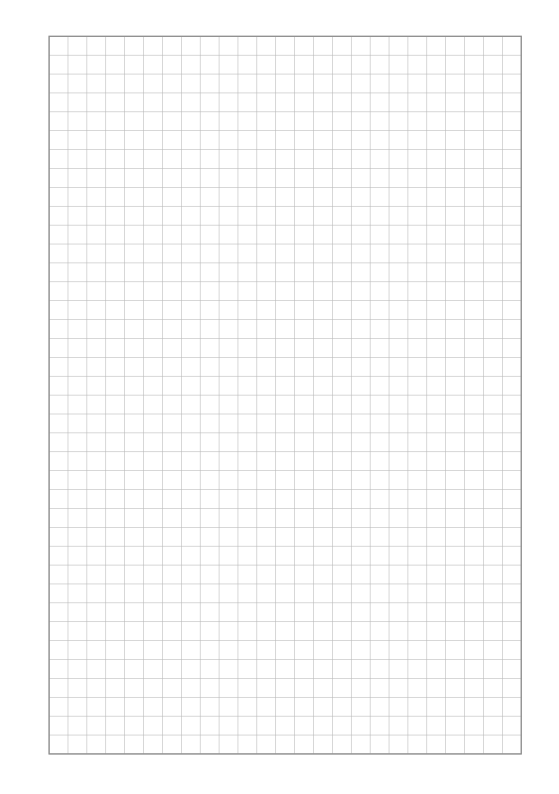
Square Grid
Quad-ruled squares for notes, math and diagrams.
-

Dot Grid
Evenly spaced dots for bullet journals and sketches.
-
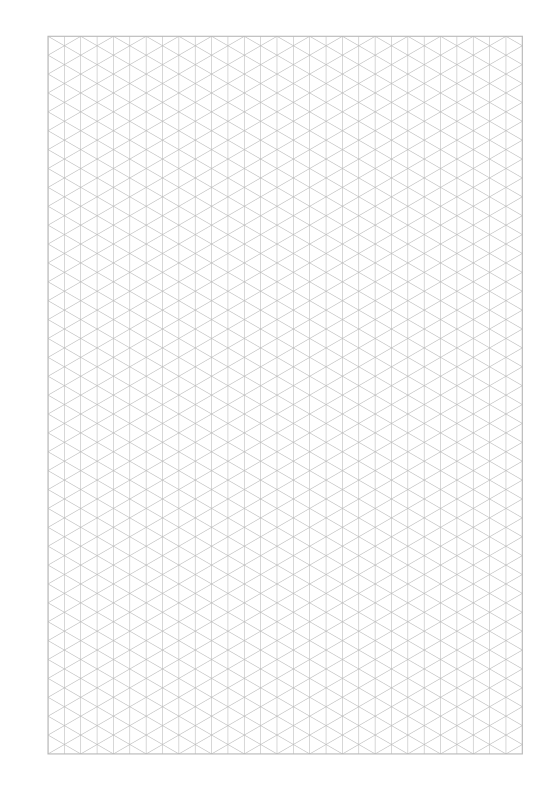
Isometric Grid
Triangular grid for 3D drawings and patterns.
-
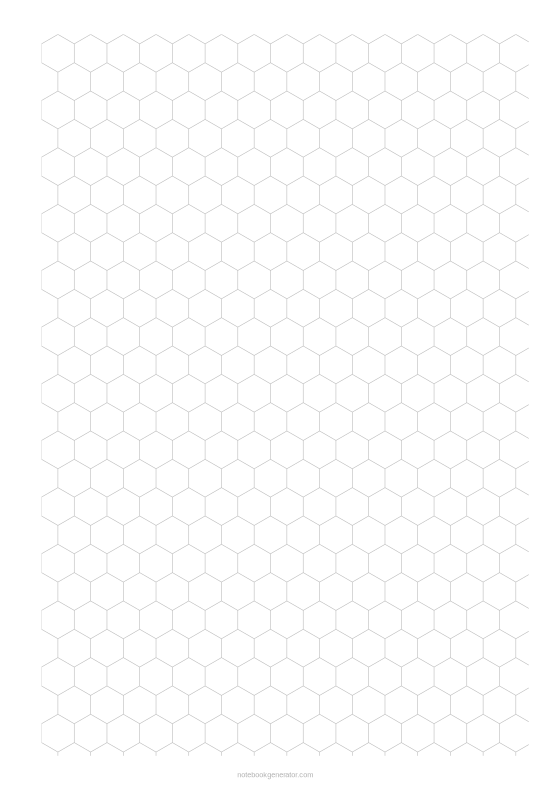
Hexagon Paper
Hex grid for game maps, quilting, chemistry and design.
-
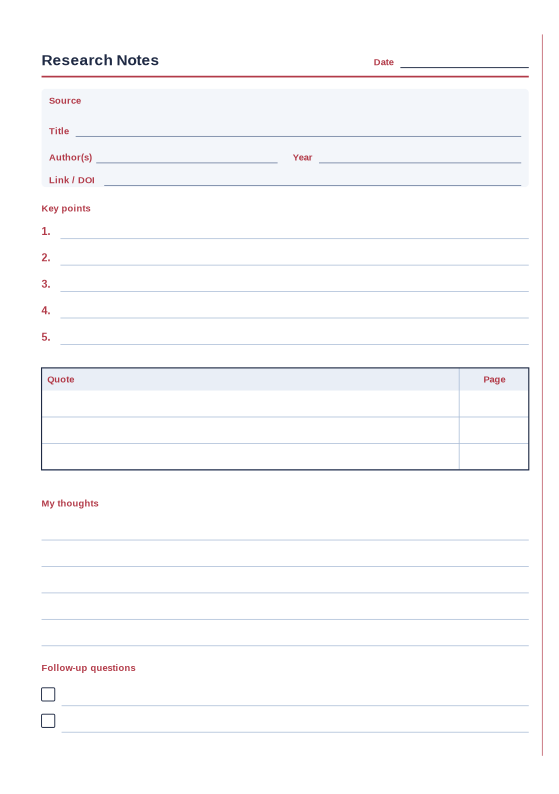
Research Notes
Source details, key points, quotes and questions.