5 min read
Note-taking methods: 6 ways to take notes compared
The Cornell, outline, mapping, charting, sentence and boxing methods explained, with a comparison table, the best paper for each and how to choose by subject.
On this page
The six most common note-taking methods are the Cornell method, the outline method, mapping (mind maps), the charting method, the sentence method and the boxing method. Each suits a different kind of material: outlines for well-structured lectures, maps for connected ideas, charts for comparisons and Cornell notes for anything you will be tested on. The right paper makes each method easier, so this guide pairs every method with a printable page.
The six methods at a glance
| Method | Best for | Paper | Effort in class |
|---|---|---|---|
| Cornell | Lectures and reading you will revise for a test | Cornell Notes | Medium |
| Outline | Well-organised lectures, textbooks | Ruled Paper | Medium |
| Mapping | Brainstorming, essay plans, connected topics | Blank Paper or Dot Grid | Medium to high |
| Charting | Comparing several items on the same points | Square Grid or Graph Paper | High |
| Sentence | Fast lectures with lots of new information | Ruled Paper | Low |
| Boxing | Topics that split into clear chunks, revision | Dot Grid | Medium |
Cornell, outline and sentence methods
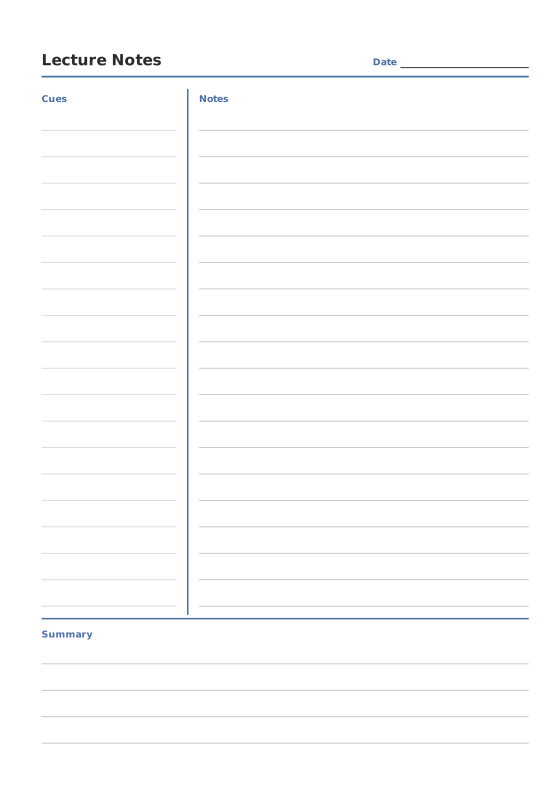
The Cornell method. You divide the page into a notes area, a cue column for questions and a summary at the bottom. Notes go on the right during class; questions go on the left afterwards, and they turn into a ready-made self-test. Use the Cornell Notes template and read the full guide to Cornell notes.
The outline method. Write main topics at the left margin and indent supporting points underneath, level by level:
- Industrial Revolution
- Causes
- New farming methods, growing population
- Coal and iron close together
- Effects
- Rapid growth of cities
- Causes
Outlines are tidy and easy to review, but they struggle when a speaker jumps between topics. Ruled Paper with a margin line keeps your indents straight.
The sentence method. Write every new fact or idea as a short sentence on its own line, numbered if you like. It is the fastest way to keep up with a quick speaker, but the structure is not visible, so set aside time afterwards to highlight and reorganise. Ruled paper works best.
Mapping, charting and boxing
Mapping (mind maps). Put the main topic in the centre of the page and draw branches out to subtopics and details. Maps show how ideas connect and are excellent for planning essays and summarising a whole unit on one page. Use Blank Paper or Dot Grid, and turn the page to landscape under Notebook → Orientation for more room.
Charting. Draw a table with one column per category and one row per item. For example, compare three revolutions by date, causes, key people and results. Charts make facts easy to compare and memorise, but you need to know the categories in advance. Square Grid or Graph Paper gives you ready-made columns.
Boxing. Group related notes inside a drawn box, one box per subtopic, and leave space between boxes. When you revise, each box is one chunk to learn and test. The method is popular with tablet note-takers, but it works just as well on paper: the dots of a dot grid make straight boxes easy to draw.
How to choose a method by subject
- Maths and physics: Cornell notes with worked examples in the notes area and “when to use this” in the cue column, or square grid for calculations and graphs.
- Languages: a Vocabulary Notebook for new words (fold the page to hide the meanings and test yourself), and charts for verb tables and grammar.
- History and social sciences: outlines for lectures, charts for comparing events, and mind maps for essay planning.
- Biology and chemistry: Cornell notes for content, plus mapping for processes and cycles.
- Meetings: Meeting Notes pages with an agenda, notes and an action items table with owner and due date.
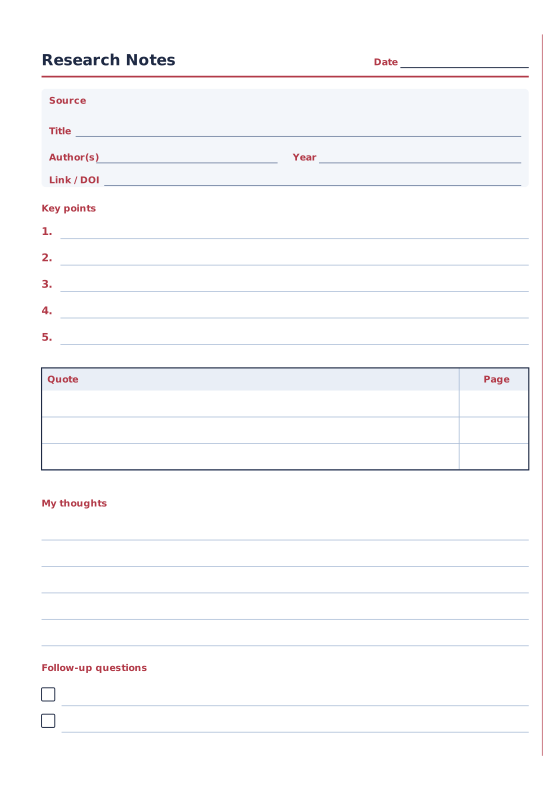
- Reading and research: Research Notes pages with the source, key points, quotes with page numbers, your own thoughts and follow-up questions.
If you are unsure, start with Cornell notes for lectures and sentences for fast talks, then add maps and charts when you revise.
Mix page types in one printed notebook
Real courses need more than one method, and a printed notebook does not have to use the same page throughout. In the maker you can combine page types in any order:
- Start with 24 Cornell pages in A5.
- Use Add pages to add dot grid pages for mind maps, square grid pages for charts and a few vocabulary pages.
- In the same dialog, After each page, also add inserts a second page type after every new page. For example, add Cornell pages with a Dot Grid page after each one, so every lecture gets a spare page for a mind map.
- Drag pages into order, then open Download PDF and choose Print-ready booklet to fold and staple the notebook.
A booklet always has a multiple of four pages; blank pages are added automatically if needed. More study setups are collected on the students ideas page.
FAQ
What is the most effective note-taking method?
There is no single best method. Cornell notes are widely recommended for studying because the cue column and summary build review into your notes, but the best method is the one that fits the material and that you will actually review.
What is the difference between outline and Cornell notes?
An outline organises notes by indenting levels of detail. Cornell notes can contain an outline in the notes area, but add a cue column for questions and a summary box for review.
Which note-taking method is the fastest?
The sentence method, because you simply write each new point on a new line. Tidy up and organise the notes afterwards.
Can I combine note-taking methods?
Yes, and most students do: outline or sentence notes in the notes area of a Cornell page, plus a mind map or chart on the facing page to summarise a whole topic.
Featured templates
Start from a template, then change line spacing, dates, colors and layout options.