5 min read
How to make a study schedule (with a printable planner)
Make a study schedule step by step: list exams and deadlines, map your week, plan sessions with spaced repetition and active recall, and print a free study planner.
On this page
To make a study schedule, list every exam and deadline, block out your fixed commitments in a weekly timetable, estimate how much time each subject needs, and spread short study sessions across the week with regular reviews. Write the plan on paper and keep it where you can see it. The five steps below take about an hour to set up and work for school, university and professional exams.
Step 1: List your subjects, exams and deadlines
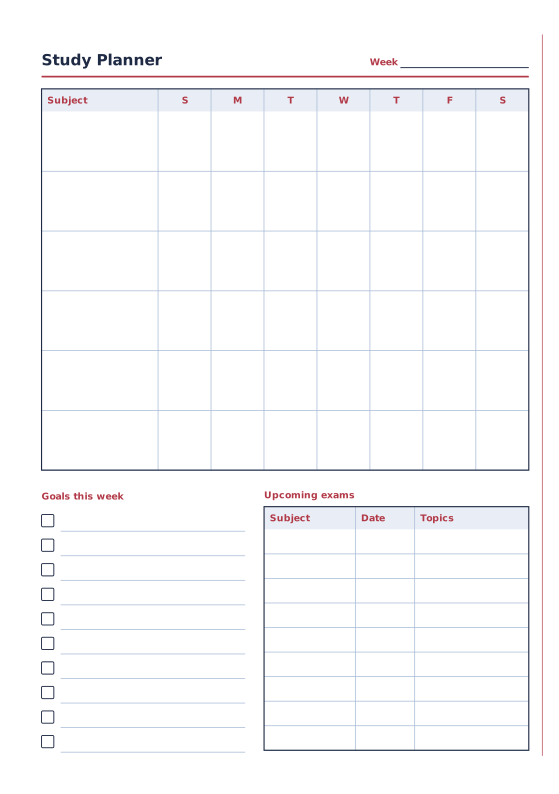
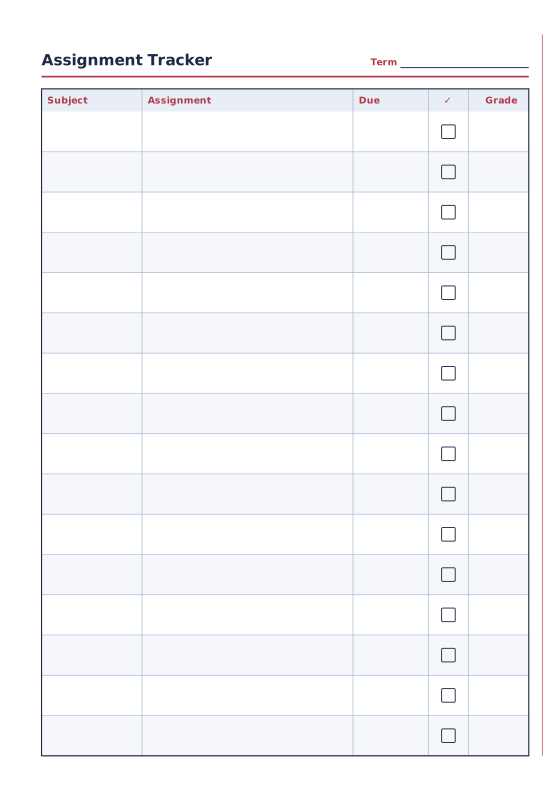
Start with everything that has a date: exams, essays, lab reports, presentations and projects. Write each one with its subject, due date and how much it counts towards your grade. An Assignment Tracker keeps them in one table with a done column, and the exam table on the Study Planner shows what is coming up this term.
Sort the list by date, then mark the subjects you find hardest. Those two things decide where most of your study time goes.
Step 2: Map your fixed commitments
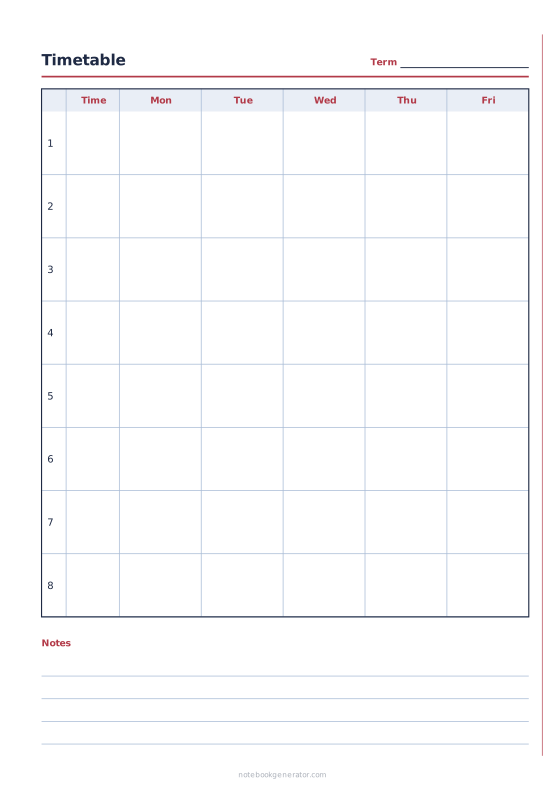
Next, fill in a weekly timetable with everything you cannot move: classes, lectures, work shifts, sport, travel time, meals and sleep. The School Timetable template has periods down the side and 5, 6 or 7 days across.
The empty spaces that remain are your real study time. Be honest here: a plan that assumes you will study every free minute will not survive the first week.
Step 3: Estimate the hours per subject
Give each subject a share of your free time based on three things: how soon the exam is, how much it counts and how difficult it is for you. A subject with an exam in two weeks that you find hard gets more sessions than one you are comfortable with. Leave one or two slots a week empty as a buffer for things that take longer than planned.
Step 4: Plan sessions that actually work
Spaced repetition. Instead of reading a topic once, come back to it at growing intervals. A common rule of thumb is to review new material after about one day, again after about a week and again after about a month. Put these reviews into the schedule as short sessions.
Active recall. Test yourself rather than rereading. Cover your notes and explain the topic out loud, answer the questions in the cue column of your Cornell notes, use flashcards or do past papers. The Vocabulary Notebook has a fold line so you can hide the meanings and quiz yourself.
Short, focused sessions. The Pomodoro Technique, developed by Francesco Cirillo, uses 25 minutes of focused work followed by a 5-minute break, with a longer break after four rounds. Two “pomodoros” make a good study block for one subject.
A sample weekly study plan
| Day | Session 1 | Session 2 | Short review |
|---|---|---|---|
| Monday | Maths: new topic (2 × 25 min) | English: essay plan | Sunday’s history notes |
| Tuesday | Biology: Cornell notes, chapter 4 | Spanish: vocabulary self-test | Monday’s maths |
| Wednesday | History: chart of causes and effects | Maths: practice problems | Biology chapter 4 |
| Thursday | Chemistry: past paper questions | Spanish: grammar | Last week’s maths topic |
| Friday | Free (buffer) | Free | Flashcards on the bus |
| Saturday | Mock exam: maths (timed) | Mark it, list weak topics | |
| Sunday | Weekly review (30 min) | Plan next week |
Each line is one or two pomodoros. The review column is where spaced repetition happens: ten minutes on something from yesterday or last week.
Step 5: Review weekly and count down to exams
The weekly review. Once a week, for about 30 minutes, look back and ahead:
- Tick off what you did and move missed sessions to next week.
- Update the assignment tracker with new deadlines and grades.
- Note which topics still feel shaky and give them an extra session.
- Fill in next week’s study planner.
The review keeps the schedule realistic. If you keep missing the same session, move it to a time that suits you better instead of blaming yourself.
The exam countdown. Two to four weeks before exams, switch from learning new material to revision. List every topic for each exam, then spread them over the remaining days so the hardest topics come up at least twice. In the last week, focus on timed practice papers and active recall, and keep your sleep regular. A Weekly Planner page per week makes the countdown easy to see.
Print your study planner
- Open the Study Planner for a term (12 weeks, A4). Set the number of Subjects (3 to 10) in the page options.
- Use Add pages to put a School Timetable and an Assignment Tracker at the front, and Cornell or vocabulary pages behind.
- For a binder, open Download PDF and choose Single pages. For a bound planner, choose A5 as the page size and Print-ready booklet to fold and staple.
More layouts for school and university are on the students ideas page. If you also want to plan your whole day, the time blocking guide shows how.
FAQ
How many hours a day should I study?
There is no single right number; it depends on your courses, exams and other commitments. Start with what you can keep up every week, plan it as focused sessions with breaks, and add more as exams get closer.
How often should I review what I have learned?
A common rule of thumb is to review after about one day, one week and one month. Each review can be short if you test yourself instead of rereading.
How long should a study session be?
Many students work in 25-minute Pomodoro rounds with 5-minute breaks, or in blocks of 45 to 50 minutes. Shorter, focused sessions usually beat long sessions where your attention drifts.
Should I plan my studying by day or by week?
Plan the week first so every subject gets enough sessions, then decide each evening exactly what you will do the next day.
Featured templates
Start from a template, then change line spacing, dates, colors and layout options.